Inverleigh: off-grid Sigenergy home and shed, 18.33 kW solar + SigenStor 48.4 kWh battery (October 2025)
A new home and shed in Inverleigh, each with its own off-grid Sigenergy SigenStor system: 12.69 kW of solar on the house and 5.64 kW on the shed, with a full year of measured results for the house.
Location: Inverleigh, Golden Plains
Switched on: October 2025
System: two separate off-grid systems, 18.33 kW of solar and 48.4 kWh of Sigenergy SigenStor storage in total. House: 12.69 kW solar (27 panels) + 40.3 kWh battery. Shed: 5.64 kW solar (12 panels) + 8.1 kWh battery
A local homeowner in Inverleigh was building a new home with a shed on the same block. Getting a grid power connection to the site would have cost too much, so solar with batteries was the more financially viable option. Our team designed and installed two separate off-grid Sigenergy SigenStor systems: a large one for the house and a smaller one for the shed.
The house system was switched on in October 2025, so it now has a full year of measured results.
12.69 kW
of solar on the house (the shed has its own 5.64 kW)
40.3 kWh
SigenStor storage at the house (the shed has its own 8.1 kWh)
7,136 kWh
supplied to the home in 12 months
100%
of the home’s power from its own solar and battery

What the homeowner wanted
The cost of connecting the block to the grid was too high, so an off-grid solar and battery system was the more financially viable way to power the new home and shed.
The site also needed power while the house was being built. We worked in with the builder to supply power during construction, then connected the off-grid solar system so the home was handed over with a working power supply from day one. We work closely with builders across Geelong on new homes like this one.
What we installed
- 39 solar panels in total (18.33 kW) across two separate systems: 27 on the house (12.69 kW) and 12 on the shed (5.64 kW)
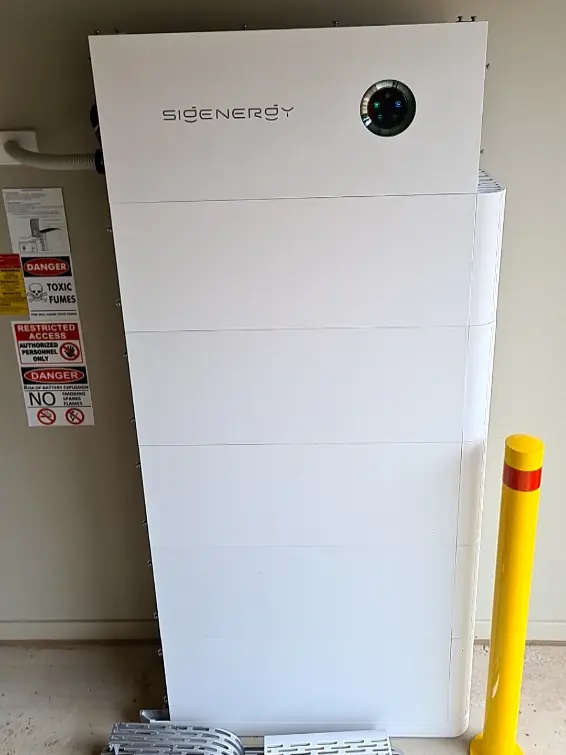
- House: Sigenergy SigenStor with five battery modules (40.3 kWh) and a built-in solar inverter, installed in the garage
- Shed: its own separate off-grid Sigenergy SigenStor with one battery module (8.1 kWh) and 5.64 kW of solar
- A Sigenergy gateway at each system. At the house the gateway also acts as the main switchboard, because there is no grid connection to feed one
- A generator inlet, fitted as a backup. To our knowledge the owner hasn’t needed it so far
- A switchboard so the builder had power during construction, then the off-grid system connected in time for handover, plus two power points and a light in the shed
- Installed by our team: designed and installed by our installation team.

How the two off-grid systems work
Off-grid means there is no power line to fall back on, so each system makes and stores all of its own electricity. On sunny days the panels run the building and fill its batteries. At night and on dull days the batteries take over. Because there is nowhere to send spare solar, each system only makes as much as its building and batteries can use, which is why the solar figure below is lower than a grid-connected system of the same size would show.
The house and shed are two separate systems. The house has 12.69 kW of solar and 40.3 kWh of storage. The shed has its own smaller system with 5.64 kW of solar and 8.1 kWh of storage.
Results so far
In the 12 months from 18 October 2025 to 17 October 2026, the house system supplied 7,136 kWh to the home, an average of about 20 kWh a day. The battery delivered 4,337 kWh of that, around 60% of everything the home used.
The monitoring recorded no energy drawn from outside the system over the year: every kilowatt-hour the house used came from its own solar panels and battery. That held through winter, when the home used 1,932 kWh from June to August 2026.
Source: Sigenergy monitoring for the house system, 18 October 2025 to 17 October 2026 (356 of 365 days recorded). The shed system’s monitoring has only reported intermittently, so it is not included.
What the homeowner said
“Great crew easy to communicate with and good quality tradesmen”
Jeremy, Google review